
Chicken Manchurian Was Born in a Mumbai Cricket Club
Nelson Wang says he made the gravy at the Cricket Club of India in 1975. Calcutta’s Chinese cooks had already been at work since the 1770s.
- manchurian
- indo-chinese
- mumbai
- kolkata
Chicken Manchurian is the glossy brown gravy from a cart or a banquet kitchen: fried chicken with garlic, ginger, and green chili, soy in the sauce, cornstarch so it holds on the spoon. The name belongs to a region in northeast China. The dish was made in Bombay.
Nelson Wang has been telling the story for years. His son Edward told the same one in a BBC interview. Wang was born in Calcutta in 1950, into a Chinese family, and arrived in Bombay in 1974. The next year he was cooking at the Cricket Club of India, the members’ club at Brabourne Stadium in Churchgate. A diner asked for something off the card. Wang has described starting with garlic, ginger, and green chili, then soy sauce and cornstarch in place of garam masala, and frying the chicken. He opened China Garden at Kemp’s Corner after that, and the gravy reached a much bigger crowd there. Most published accounts date the opening to 1983. He has also said 1984. Calcutta’s Chinese kitchens were already old when he fried that chicken.
Calcutta was already cooking
The dated beginning is Tong Atchew, also written Yang Dazhao. In 1778 Warren Hastings, governor-general of Bengal, granted him about 650 bighas by the Hooghly, a large riverside plot rented at 45 rupees a year, for a sugar mill. The village is still called Achipur. A company letter in December 1783 is already trying to collect from his estate, so he had died. His workers moved up to Calcutta.
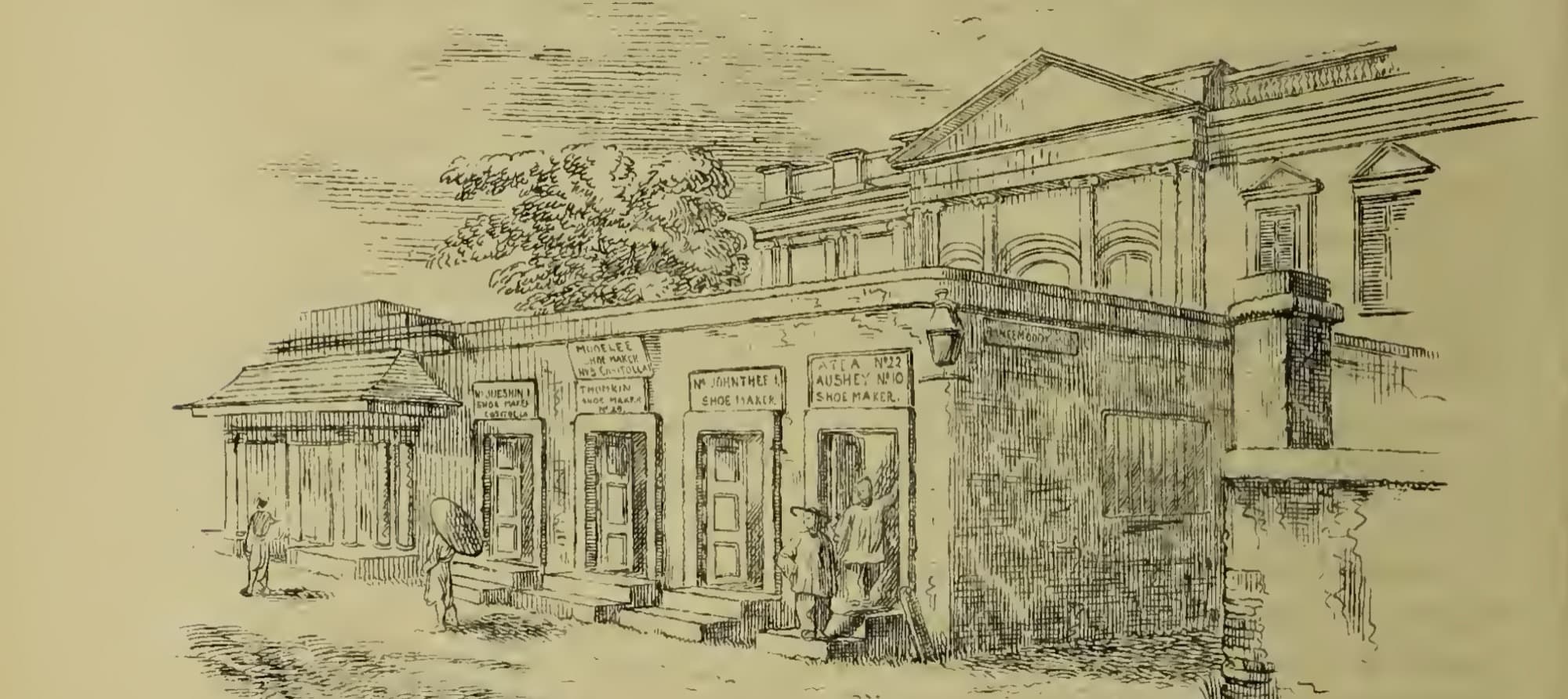
Tiretta Bazar, the old Chinatown, takes its name from Edward Tiretta, an Italian who owned the market ground. Cantonese and Hakka cooks, carpenters, and shoemakers worked the lanes around it. The drawing above is Colesworthey Grant’s 1849 sketch of that corner: Chinese shoemakers in Cossitollah, now Bentinck Street. He counted about twenty-five of them, some busy enough to hire Bengali assistants. Eating houses shared those streets. Hakka noodles still use the community’s name. An early breakfast at Tiretta Bazar can mean pork with pickled mustard greens, fish balls, or a steamed bun, food with little relation to the brown gravy on a Delhi cart.
Tangra, farther east, was the tannery quarter. During the 1962 war with China, thousands of people from India’s Chinese communities, including Calcutta’s, were interned at Deoli, a camp in Rajasthan. Many families left the city afterward. Counts that once put the population near 20,000 now sit in the low thousands, and they do not agree with each other. The cooking remained. Old tannery sheds in Tangra were turned into dining rooms. Away from Churchgate, the same coating went onto cauliflower and paneer, and the dish became an ordinary order.
Soy, chili, and cornstarch
A cook in Shenyang, the large city of what maps used to call Manchuria, would not recognize the plate. Home cooking in northeast China leans on millet, soybeans, and pickles. Manchow soup is this gravy thinned with stock, under a name that shortens Manchuria. Chili chicken, hakka noodles, and American chop suey, the crisp-noodle plate in a sweet hot sauce, belong to the same Indian restaurant family. Street stalls often finish Manchurian with vinegar or a spoon of ketchup. That sweetness comes from the cart.
Order the 1975 dish when you want it: chicken or gobi, hakka noodles beside it. For the older kitchen, go to Tiretta Bazar before the breakfast stalls shut, or take a table in Tangra and ask what they cook on an ordinary night.