
How to Order Biryani When the Menu Just Says Biryani
Hyderabadi dum, Lucknowi, and Kolkata potato-and-egg are different pots. Ask which one is in the handi.
- biryani
- hyderabad
- lucknow
- kolkata
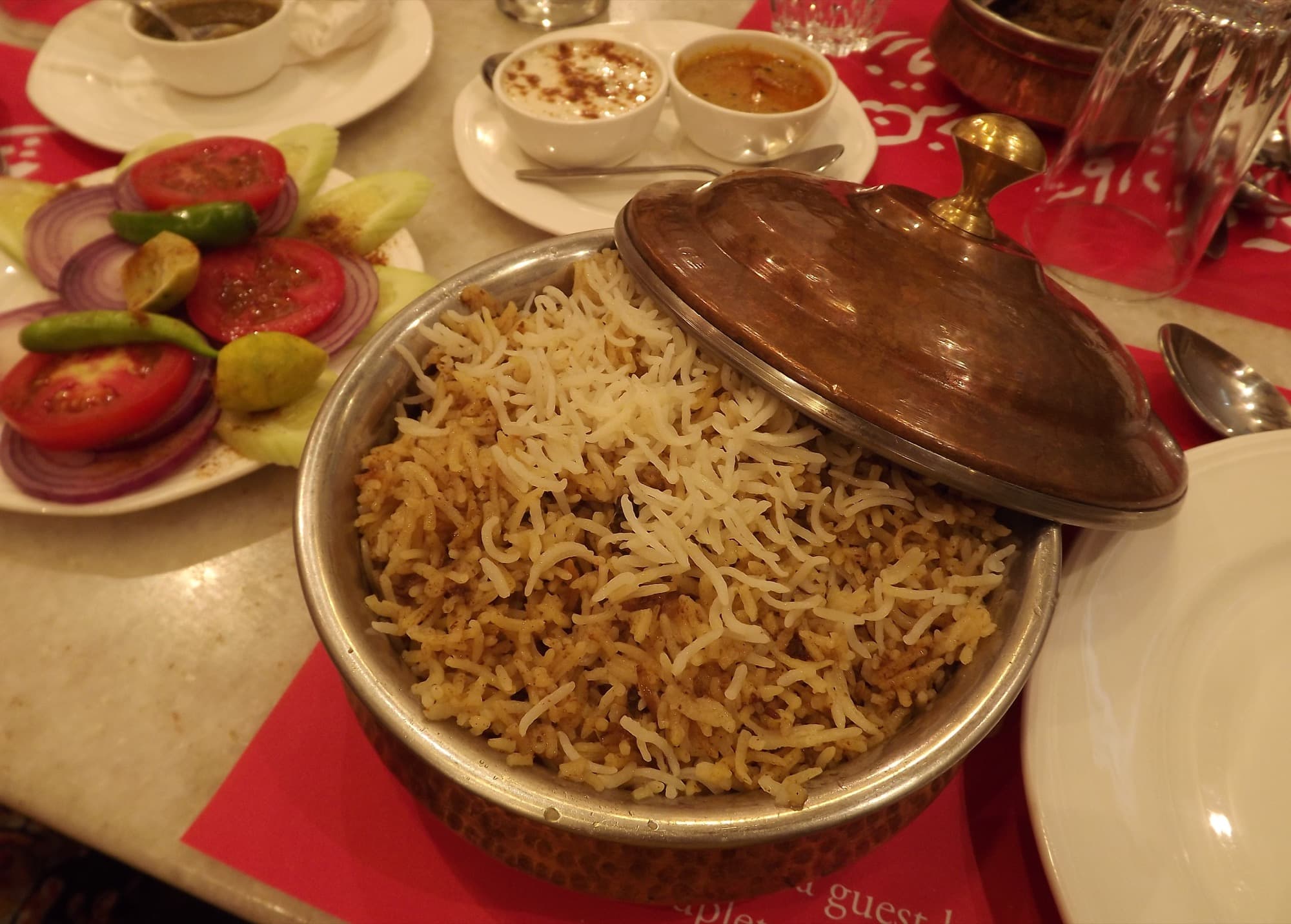
The line on the menu says chicken biryani and then nothing else. One plate is long grains with fried onion at the bottom of the pot. Another is rice so pale it looks plain, until the rose water hits. A lighter serving may come with a potato the size of a small fist and a boiled egg. The card rarely says which of those is yours.
This page is for that order: how to tell Hyderabadi dum, Lucknowi, and Kolkata apart, and what to ask when the menu only says biryani.
Hyderabad
Hyderabadi biryani belongs to the court of the Nizams, who ruled the city from the early 1700s until 1948. The rice is basmati. Fried onion, mint, and saffron go in, and there is enough chili that the grains take a red-brown cast. When a menu prints the city and stops there, this is the pot it means.
Kacchi and pakki are the two methods, if the kitchen uses those words. Kacchi puts raw meat, marinated in yogurt, under rice that is only partly cooked. The handi, a heavy round pot, is sealed, and the meat finishes in the steam. That is the version Hyderabad is known for, and it needs the full time: cut the dum short and the meat can stay underdone, or the rice turns soft. Pakki cooks the meat before it meets the rice, then steams the layers for less time, so the grains stay a little drier. Plenty of restaurants outside the city cook pakki and still print Hyderabadi. Eat either one when the fried onion, the mint, and the chili are in the pot.
Sufiyani, if the menu uses the word, is the paler pot: little or no red chili, and often still kacchi. Take it when you want the dum and you do not want the burn.
Ask for mirchi ka salan with it. That is green chilies in a gravy of peanut, sesame, and tamarind, and a spoonful on a bite is enough. The rice should stay in separate grains. Raita, yogurt with onion or cucumber, cools that same bite. Some houses also send baghare baingan, eggplant in a gravy built on the same nuts. If you add only one thing, make it the salan.
Mandi, if it is on the same card, is a different rice. It is Yemeni. In Hyderabad it is especially a Barkas dish, from the neighborhood on the city’s south edge, where families from Yemen have cooked it for generations. The meat hangs above the grains so the fat drips down, often over a pit or in a tandoor. Order it for the smoke, and for a platter the table can share. The dum is the sealed pot.
Lucknow
A Lucknow biryani can look plain if you came for the Hyderabad pot. The rice is often almost white. What you smell is cardamom, mace, and kewra, screwpine water, sometimes rose. Chili is light. Some kitchens leave it out.
The foundation is yakhni, a meat stock the meat simmers in until it is tender. Whole spices often go in tied in a cloth, so the perfume gets into the rice and a red masala never appears. Cooks in Awadh, the old name for the Lucknow region, still cook it that way. The flavor stays in the stock.
Restaurant kitchens usually cook this one pakki: meat nearly done, rice boiled most of the way, then a sealed steam. Some Lucknow cooks call that pale pot a pulao and will not use the word biryani. Use the name they use. If you want heat, order a different city.
Kolkata
The potato should taste like the meat. It is large, stained with saffron, and soft enough to take the gravy through. A boiled egg often sits beside it. The chili is quieter than in a Hyderabad pot.
The usual account starts in 1856, when the British deposed Wajid Ali Shah, the last nawab of Awadh. He settled at Metiabruz, then on the southern edge of Calcutta, and brought cooks from the Lucknow kitchen with him. Manzilat Fatima, his great-great-granddaughter, has said the potato went in a few years later. Meat was the expensive part, the tuber was still a novelty, and it let the pot feed more people. The potato became the dish. If a Kolkata biryani arrives without one, you are eating some other recipe. Eat the potato with the meat.
When the menu names a town
Ambur, from the Arcot towns in northern Tamil Nadu, is built on seeraga samba, a short grain with more chew than basmati, and a chili paste that turns the pot orange and a little wet. Dindigul, farther south, is darker, with curd in the mix and a peppery finish. Ask for dalcha, a sour lentil stew, or for raita. These plates do not come with mirchi ka salan.
Thalassery biryani, also called Malabar, uses kaima, a short grain also sold as jeerakasala. Ghee is generous, the chili is gentler than Ambur, and fried cashew and raisin are common. Onion and lime show up beside it more often than a bowl of gravy.
Sindhi biryani is sharper, soured with yogurt cooked into the pot, and potato is common there too. Taste the yogurt in it. A potato by itself does not make the plate Kolkata.
Donne biryani is the Bengaluru order, served in a dried-leaf cup, and it usually runs hotter than a Hyderabad dum.
Pulao, and the mixed pot
Pulao cooks the rice in the stock. The grains take on one flavor, and the color tends to run all the way through. Biryani usually cooks the meat and the rice apart, then finishes them under a seal, so the bottom of the pot can be wetter than the top. Lucknow sits close to both ideas, which is why a cook there can hand you a pale pulao and be right. In most other restaurants, yellow rice with the chicken stirred evenly through it was mixed in one pot. The menu still said biryani.
Tehri is the vegetarian rice of Uttar Pradesh: vegetables, fried onion, and spice cooked with the grain. A line that says veg biryani may mean tehri. It may also mean peas in seasoned rice. Ask which.
What to say
If a city is printed, order that city: Hyderabad with the salan and the raita, Lucknow as the kitchen cooks it, Kolkata so you can eat the potato with the meat.
If the line is only chicken biryani, try this. “Is there potato in it? I’ll take that if there is. If you cook a Hyderabadi dum, I’ll have that, with the salan.”
You can check the plate when it lands. A saffron potato and an egg is the Kolkata pot, so eat the potato with the meat. Peanut gravy beside red-brown rice is Hyderabad. Pale rice that smells of kewra is Lucknow. If the chicken is only stirred through yellow rice, you got the mixed pot. Eat it as rice, and add a curry if the meal still feels thin.