
How to Order at a South Indian Dosa Counter
Masala dosa, paper dosa, uttapam — what to ask for when the menu assumes you already know.
- dosa
- ordering
- south indian
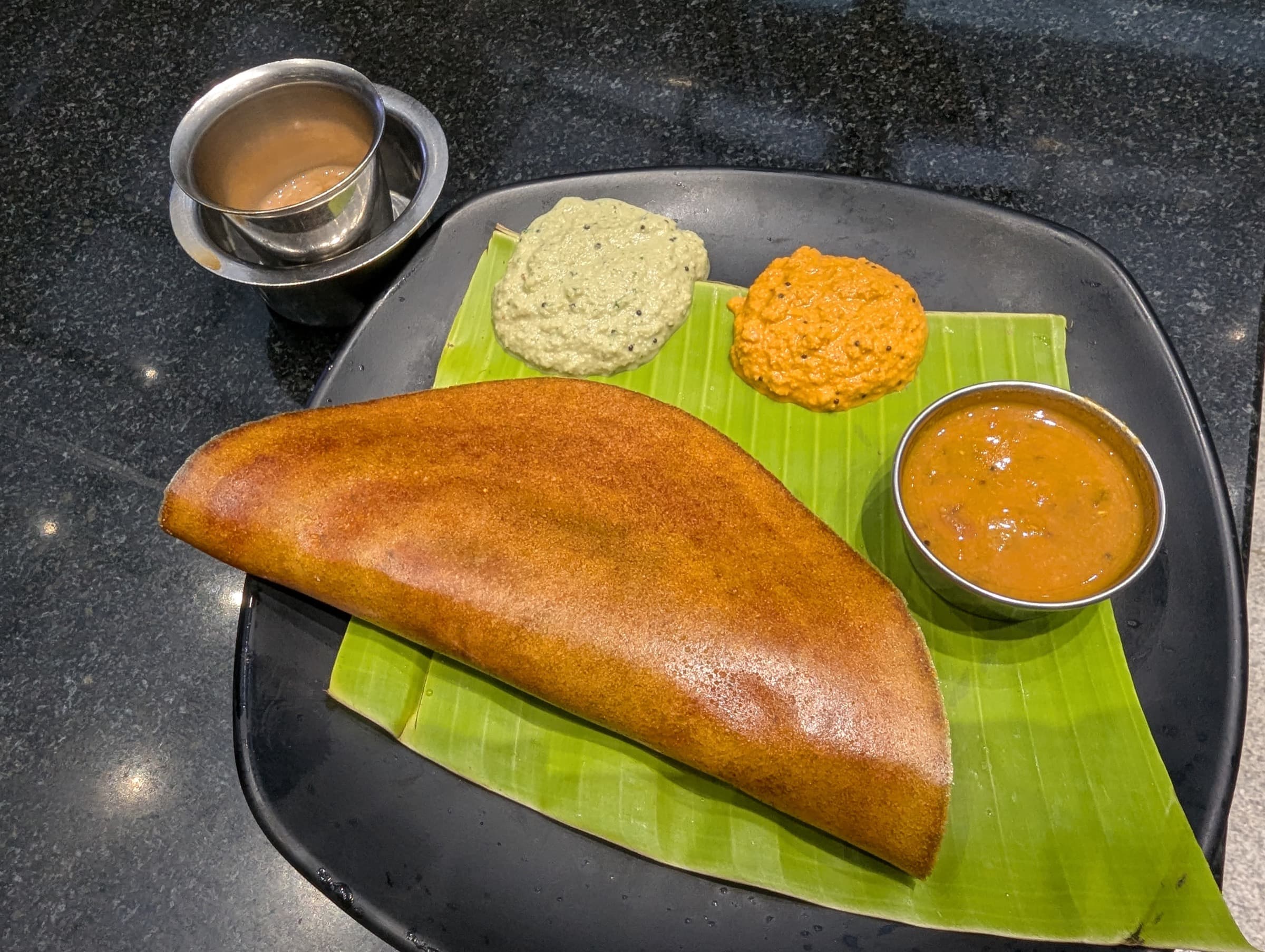
This page is for the moment you know the words — masala dosa, sambar, coconut chutney — but the room moves faster than the menu. A South Indian dosa counter (Bengaluru darshini, Tamil Nadu tiffin room, temple canteen, some diaspora Udupi spots) is a system: pay, token, plate, eat while it is still crisp. It is not a leisurely curry-house script.
Counter, not curry house
In a Bengaluru darshini you usually pay first at the cashier, take a token, and collect food from the dose or idli-vada window. You may stand at a steel ledge. Legacy tiffin rooms keep queues and shared tables but the same speed. A Chennai mess may use tokens and banana leaves. A Queens temple canteen may put chutney and sambar in self-serve vats. If someone seats you, hands you a laminated novel of cheese dosas, and waits for a tip, you are in a restaurant that serves dosa — fine, but the scripts below are for the fast rooms.
Say the dosa you want
- Plain / sada — the crepe alone, no potato.
- Masala — crisp dosa with spiced potato; the default safe order.
- Paper / paper roast — thin, large, loud crunch; often little or no filling.
- Set — two or three small soft dosas that soak chutney well (Karnataka-leaning).
- Rava — lacy semolina batter, often with onion and chili.
- Ghee roast / nei dosa — cooked in ghee; usually about fat and aroma more than filling.
- Benne dose — Karnataka butter territory; potato may arrive on the side.
- Onion — thicker, topped with onion and chili (uttapam-adjacent).
- Podi / gunpowder — milagai podi with ghee or sesame oil; mix into a paste, or order podi dosa.
- Cheese — common on diaspora menus; treat it as a branch, not the trunk.
Chutney, sambar, podi
Coconut chutney cools. Tomato or red chutney hits sharper. Sambar is for dipping or spooning — ask if a cup is not automatic; older darshinis were sometimes chutney-first. Gunpowder wants fat mixed in; do not eat the dry powder alone unless you enjoy that. Heat lives in the sides more than in a North Indian “mild / medium / hot” scale, unless staff offer one.
Beginner script and regular script
Beginner, almost anywhere: “One masala dosa. Coconut chutney and sambar. Filter coffee after.” Eat with your hands if that is the house habit — tear, dip, do not wait for it to steam soft. Parcel if you are walking; ask for filling separate if you want the dosa to stay crisp longer.
Regular, token already paid: “Ond masale.” Skip red chutney smear with “kempu chutney beda” where that language fits. Finish with filter coffee in a steel tumbler and davara if the house still pours it that way — stretch between tumbler and bowl to cool it.
Sources and further reading
- Wikipedia: Dosa)
- Medium: 101 guide to a Bengaluru darshini
- Saveur: Indian dosa crepes guide
- Wikimedia Commons: Rameshwaram Cafe Dosa