
Why North Indian Food Still Owns Most American Menus
Wheat, dairy, and the buffet made Punjabi-Mughlai the default. South Indian corridors and starred rooms are catching up.
- north-indian
- south-indian
- dosa
- butter-chicken
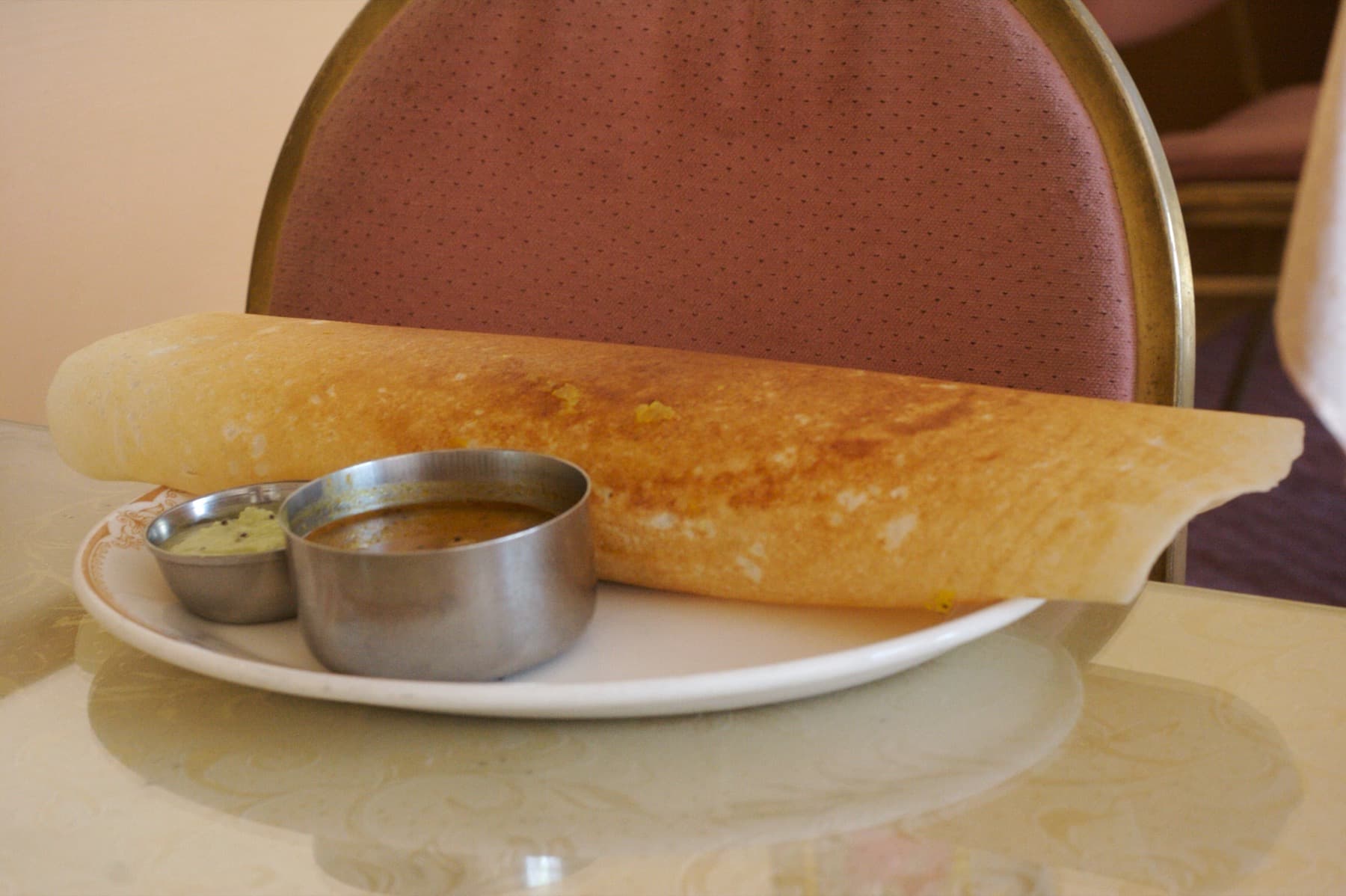
Order “Indian” in most of America and the foil comes back familiar: butter chicken or tikka masala, saag paneer, a rack of naan, maybe a steam-table buffet if it is still lunch. Drive El Camino Real through Sunnyvale on a weekend and the line is different: Andhra thali, pesarattu, gunpowder dosa, Hyderabadi dum biryani. What actually separates North and South Indian food, and which one is more popular in the United States?
The North Indian restaurant template still owns mainstream American menus and takeout bags. South Indian cooking is winning the corridors where Tamil, Telugu, Kannada, and Malayali communities cluster, and it is winning a lot of the critical attention. North and south are a useful starter map. They are also blunt. India cooks east, west, and northeast too, and Hyderabad sits awkwardly on any tidy dividing line.
What the north-south split actually describes
Geography shaped the pantry first. The northern wheat belt grew roti, paratha, and later restaurant naan. Much of the south grew rice as the daily center, then fermented rice-and-lentil batters into idli, dosa, and appam. Dairy runs loud across Punjabi and Delhi restaurant food: ghee, yogurt, cream, paneer. Coastal southern kitchens lean on coconut as oil, milk, or grated finish, with gingelly (sesame) and groundnut oils inland. Sourness splits too. Yogurt, dried mango, and tomato thicken many northern gravies. Tamarind, kokum, buttermilk, and raw mango brighten a lot of southern pots.
Technique follows the pantry. The clay tandoor, slow onion-tomato masalas, and thick makhani sauces define the commercial north that traveled abroad. Southern kitchens put more weight on steaming, fermentation, and thalippu, the mustard-seed-and-curry-leaf tempering poured over dals, vegetables, and chutneys. Heat is not a north-mild / south-hot cartoon. Kashmiri chilli often gives color more than fire. Chettinad black pepper and Andhra dried chilli do different work than a buffet “spicy” slider. For a fuller atlas, see Indian Regional Cuisines Explained.
A plate test helps more than a stereotype. Tear soft bread through a dairy-forward gravy and you are usually in the commercial north. Scoop thin, tangy gravy with rice, or tear a crisp fermented crepe into coconut chutney and sambar, and you are closer to southern meal logic. Neither plate is automatically lighter. A ghee-heavy dosa breakfast and a cream-forward buffet chicken both land hard.
Where the binary breaks
“North Indian” on a U.S. menu rarely means Kashmiri wazwan, Rajasthani dal baati churma, or Himachali madra. It usually means a Punjabi-Mughlai restaurant product line: tomato-cream gravies, tandoor meats, naan, paneer, mild-to-hot. That product has real history, including Partition-era Delhi tandoor rooms and Moti Mahal’s butter chicken story. It still flattens a huge region. We unpack that label in What “North Indian” on a Restaurant Menu Is Hiding.
“South Indian” is just as crowded. Udupi vegetarian thalis, Chettinad pepper chicken, Kerala toddy-shop seafood, Andhra gongura, and Tamil Muslim biryanis do not share one gravy. Hyderabadi dum biryani, often filed as southern on American cards, sits in a Deccan court tradition that is neither Delhi hotel north nor Tamil rice-meal south. East (Bengali mustard fish), west (Gujarati thali, Goan vinegar pork), and northeast (Assamese tenga, fermented bamboo) fall outside the binary altogether. Use north and south for orientation, then ask for the smaller address.
Why North Indian food won America first
Early U.S. Indian rooms, especially from the 1950s through the mall-buffet decades, sold food that already worked for Western diners: grilled meats, soft breads, thick sauces that held under a heat lamp. British curry-house menus arrived secondhand. Chicken tikka masala, a British national shorthand with contested invention stories, taught Americans a mild, tomato-cream Indian dinner before most of them met a dosa. Anthropologist Tulasi Srinivas, writing for the Association for Asian Studies’ Education About Asia, put the result cleanly: Indian food billed abroad is often reimagined north Indian eatery fare, a Punjabi-Mughlai blend modified for local taste, with the nation’s wider diversity underrepresented.
Economics locked it in. Immigrant entrepreneurs needed a card that sold on the first visit. Creamy gravies travel in takeout foil. Tandoor meats look familiar next to American grill culture. A lunch buffet turns unfamiliar names into a low-risk sampler. Fermented batter, made-to-order dosa, and fresh coconut chutney are harder to run as a twelve-dollar all-you-can-eat line. Food studies scholar Krishnendu Ray has long noted how Indian-American restaurants compressed the country’s dispersal of taste into one or two restaurant styles. The buffet did diplomatic work. It also taught a generation that “Indian” meant naan and makhani.
Why South Indian food is closing the gap
The customer base changed. After 1965 immigration reform and especially after the H-1B tech wave, Tamil, Telugu, Kannada, and Malayali communities built density in places like Edison, New Jersey; the Bay Area’s El Camino corridor; Dallas and Austin suburbs; and parts of the Research Triangle. Those diners already wanted rice meals, tiffin breakfasts, and named regional heat. Sunnyvale’s Andhra strip did not wait for a national trend piece. It fed people who missed home food on Tuesday.
Chains and critics followed. Saravanaa Bhavan and other dosa houses made the idli-dosa-vada set legible nationwide. Filter coffee and benne dosa pulled South Indian breakfast into wider chatter. On the prestige end, Semma’s Michelin star for rural Tamil cooking, Copra’s coastal South Indian room in San Francisco, Chicago’s Thattu, and Kerala toddy-shop rooms like Chatti in Manhattan showed southern food could carry a reservation night. Industry trackers now list dosa, chicken 65, filter coffee, and parotta among rising U.S. Indian formats, even while butter chicken still anchors the default takeout order. For the longer hyper-regional turn, see Beyond Butter Chicken.
So which is more popular?
If “popular” means the food most non-South Asian Americans still order and the template most small-city Indian restaurants still print, North Indian restaurant food wins. Walk into Houston, Cleveland, or Sacramento without a regional tip and you will usually meet tikka masala, butter chicken, and naan before you meet rasam. Market researchers such as Datassential have tracked more Indian openings and upscale rooms in recent years, but the steam-table card remains the country’s first language.
If “popular” means what diaspora corridors eat weekly, and what critics reward when they look past the buffet, South Indian cooking is the louder growth story of the last decade. Those are different scoreboards. People hear that butter chicken is finished while the foil bag at the airport still says otherwise.
For the next order, ask which region is on the plate before you ask for mild or hot. Tear naan through a gravy when you want the commercial north. Order a dosa with sambar, a Kerala fish curry with rice, or an Andhra thali when you want the southern map. Then go smaller: Chettinad, Kashmiri, and Kerala are addresses, not heat levels. Start with our Dosa Counter Ordering Guide or Why Non-South Asians Love Butter Chicken depending on which night you are planning.