
What “North Indian” on a Restaurant Menu Is Hiding
One label covers Punjabi, Awadhi, Kashmiri, Rajasthani, and hill kitchens. Here are the menu words that tell you which one you are eating.
- north-indian
- menus
- punjabi
- awadhi
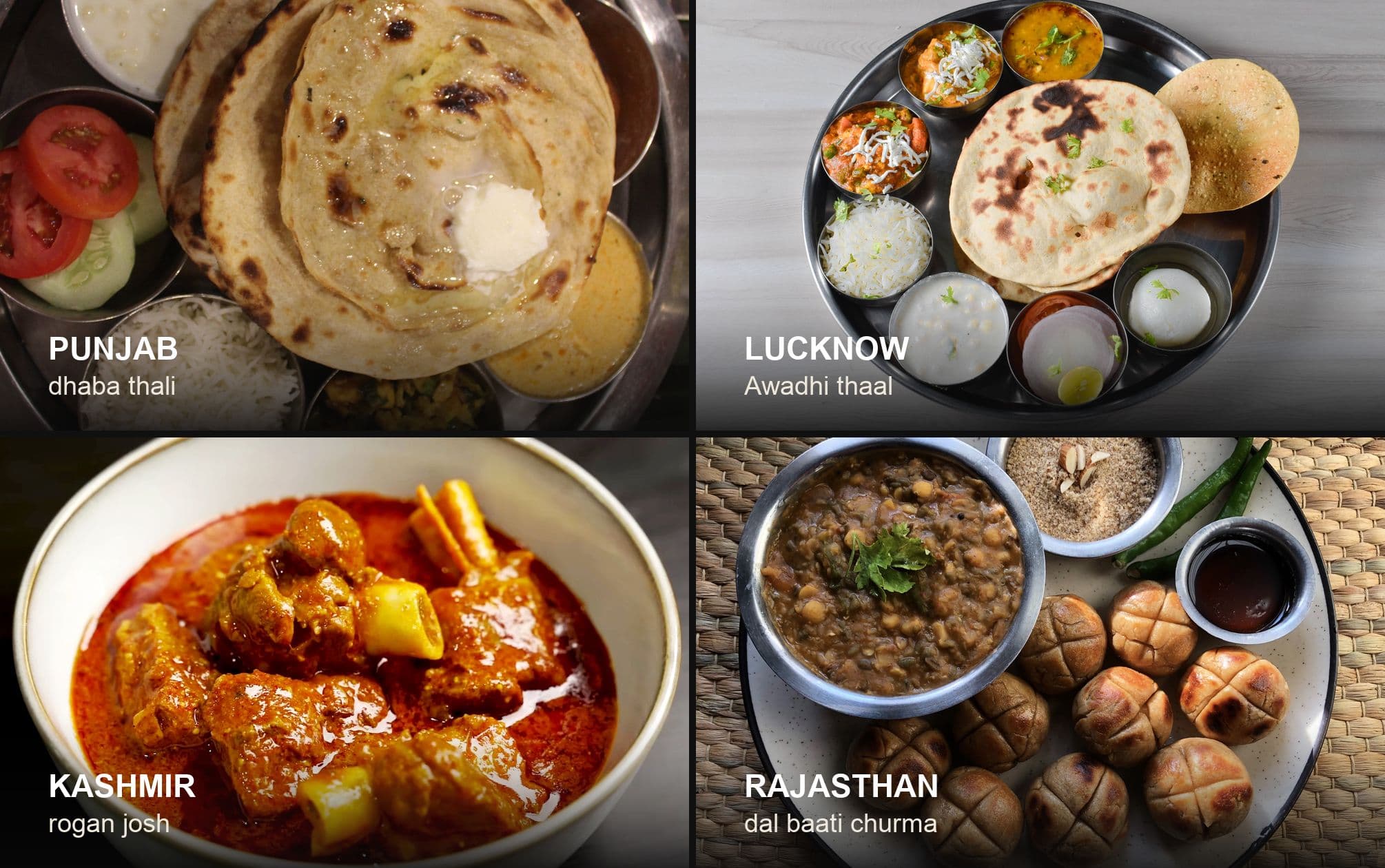
On most diaspora menus, “North Indian” works less like a place than a product line: tomato-cream gravies, tandoor meats, naan, a mild-to-hot heat ladder, and a vegetarian page built around paneer. The label earns its keep when a kitchen really does cook from the wheat-and-dairy belt. More often it flattens Punjabi, Awadhi, Kashmiri, Delhi, Rajasthani, and Himachali cooking into one creamy commercial category.
This page is a reading guide. How the restaurant category got built, which words on a menu still give away a region, and how to ask better questions without turning dinner into an authenticity exam.
How “North Indian” became a restaurant category
The geography is real. Northern India covers Punjab, Haryana, Delhi, Uttar Pradesh, Rajasthan, Himachal Pradesh, Uttarakhand, Jammu and Kashmir, and more, and wheat breads, dairy, yogurt and slow meat cookery do run across that map. Mughlai cooking, developed in the imperial kitchens of the Mughal court with Persian and Central Asian inheritance, and Awadhi cooking, refined under the nawabs of Lucknow, both sit inside that broad north. Neither is interchangeable with a Punjabi farmhouse lunch.
The restaurant version narrowed for reasons that had little to do with taste. By the account of the men who later built Old Delhi’s first big tandoor rooms, the city had almost no restaurant-going habit before 1947; people ate at home, or bought fried breads in lanes like Paranthe Wali Gali. Partition pushed Punjabi families, many of them from Peshawar, into the capital, and some rebuilt their livelihoods by feeding it. Tandoors went in, naan and tandoori chicken went on the fire, and the tomato-butter gravy now sold worldwide as butter chicken came out of that same Daryaganj scene, successfully enough that two restaurant families later took the question of who invented it to the Delhi High Court.
Abroad, British curry houses and North American buffet rooms scaled a version of that Punjabi and Mughlai card because it held on a steam table and needed no explaining. Association for Asian Studies teaching material puts the result plainly: what most foreign menus call Indian food is reimagined North Indian eatery fare. That cooking has real history behind it, including a refugee business story worth knowing. It is still one slice of the north.
Punjabi restaurant food versus Punjabi home food
Punjabi restaurant cooking leans on the tandoor, thick makhani and masala gravies, dal makhani, butter chicken, and stuffed parathas. That food is loved for good reason, and it is one register out of several. The seasonal home table looks different: sarson da saag with makki di roti when the mustard greens come in, rajma chawal on a weeknight, plain dry sabzis, salted lassi rather than the sweet mango version. Dhaba cooking, the roadside style, can be loud and ghee-heavy without ever reaching a hotel buffet’s cream level.
So when a menu says North Indian and then sells only makhani, korma and tikka masala, you are meeting the commercial register, not the full Punjabi table. For the household version, see The Punjabi Table.
Awadhi technique and its frequent mislabeling
Awadhi cooking, centered on Lucknow, gets filed under Mughlai on diaspora cards constantly. The overlap is genuine, since sealed dum cooking, perfumed rice and pounded-meat kebabs share a courtly ancestry. The difference shows up at the table. Awadhi kitchens are known for lighter aroma, careful fat, and kebabs built for softness: galouti, whose name points at melting, and kakori, ground fine enough to barely hold its shape. Warqi paratha, a layered flaky bread, and slow dum biryani are technique claims, not decoration.
If a card says Mughlai beside a cream-forward chicken dish, with no dum, no kebab craft and no Lucknowi breads, the word is doing marketing work. Kitchens that actually cook Awadhi tend to say so: Lucknow, Awadh, galouti, kakori, dum. London’s Oudh 1722, Aktar Islam’s Awadhi room in Borough, is one diaspora example of that naming habit; see Oudh 1722 Brings Awadhi Lucknow Cooking to London.
Kashmiri, Rajasthani, and Himalayan distinctions
Kashmiri red comes from chilli variety and technique rather than a tomato-cream base. Rogan josh in Kashmiri kitchens tends to take color from mild Kashmiri chilli and aroma from fennel and dried ginger, loosened with yogurt instead of thickened with cream. Households fork hard here: Pandit cooking often works without onion and garlic, while Muslim kitchens use both, and the two traditions sequence a feast differently. Wazwan, the formal multi-course Kashmiri banquet, is not a lunch special, and no honest kitchen serves the whole of it on a Tuesday. If a menu says Kashmiri, ask which tradition it is cooking.
Rajasthani food grew around aridity and preservation, which is why it behaves nothing like Delhi hotel gravy. Dal baati churma pairs lentils with hard baked wheat rolls and a sweet crumble; gatte ki sabzi simmers gram-flour dumplings in a tangy yogurt sauce; ker sangri is built from dried desert berries and beans; laal maas takes its heat from Mathania chillies. Himachali and other pahadi, or hill, kitchens lean on madra, a yogurt-based curry, steamed stuffed breads like siddu, and dham, the Kangra feast served on festival days. Those plates rarely survive a menu that only knows naan and makhani.
Menu words that reveal regional origin
- Punjabi and dhaba cues: sarson da saag, makki di roti, amritsari kulcha, dal makhani, tandoori, stuffed paratha, salted lassi.
- Awadhi and Lucknowi cues: galouti, kakori, dum biryani, warqi paratha, sheermal.
- Kashmiri cues: rogan josh with fennel and dried ginger, yakhni, gushtaba, rista, nadru, haaq, kahwa.
- Rajasthani cues: dal baati churma, gatte, ker sangri, laal maas, missi roti, bajra roti.
- Himachali and pahadi cues: siddu, chana madra, sepu vadi, dham, anardana for souring.
- Delhi restaurant cues: butter chicken, chaat, nihari at an old-city breakfast counter, and a mixed Mughlai and Punjabi hotel page.
Technique words carry as much information as place names. Dum means sealed low heat. Bhuna means cooking until the fat separates. Tandoor is clay-oven fire. Mustard oil, hing-forward Jain plates, or a coconut and curry-leaf tempering point away from the cream-north template entirely.
Questions to ask without demanding “authenticity”
- Which part of the north is this kitchen cooking: Punjabi restaurant style, Lucknowi, Kashmiri, Rajasthani, hill food, or a mix?
- What would the cooks eat here on their own break?
- What bread belongs with this dish: naan, roti, warqi paratha, missi, or bajra?
- If a dish is labeled Mughlai, what technique makes it Mughlai here?
- Is anything on the card seasonal, or cooked only for festivals?
None of this has to be run like a checklist at the table. One word usually does the work. If ker sangri or chana madra turns up on a card otherwise full of makhani, that is the dish somebody in the kitchen is proud of, and ordering it tells them the specificity landed.
A starter dish from each tradition
- Punjabi: sarson da saag with makki di roti in season, or a plain dal tadka before you reach for dal makhani.
- Awadhi: galouti kebab with thin paratha, or a dum biryani from a kitchen that names Lucknow.
- Kashmiri: rogan josh or dum aloo, once you know which tradition the kitchen follows.
- Rajasthani: dal baati churma, or gatte ki sabzi for the vegetarian desert logic.
- Himachali: chana madra, or siddu if the kitchen actually steams the bread.
- Delhi restaurant north: butter chicken is fair game. Just do not let it finish the map.
Further reading
- Why “Indian Food” Is the Wrong Menu Category
- Beyond Butter Chicken: Why South Asian Dining Got Hyper-Regional
- The Punjabi Table
- Oudh 1722 Brings Awadhi Lucknow Cooking to London
- Idli With Fire-Grilled Carrots Just Won Australia’s Best New Talent Award
- Goldscene: Drāvida maps South Asian cooking in the East Village