
How Vikas Khanna Became the Indian Chef America Could Name
Junoon, MasterChef India, Bungalow, TIME 100: the climb that made “Indian chef” a job with a public name.
- vikas-khanna
- junoon
- bungalow
- new-york
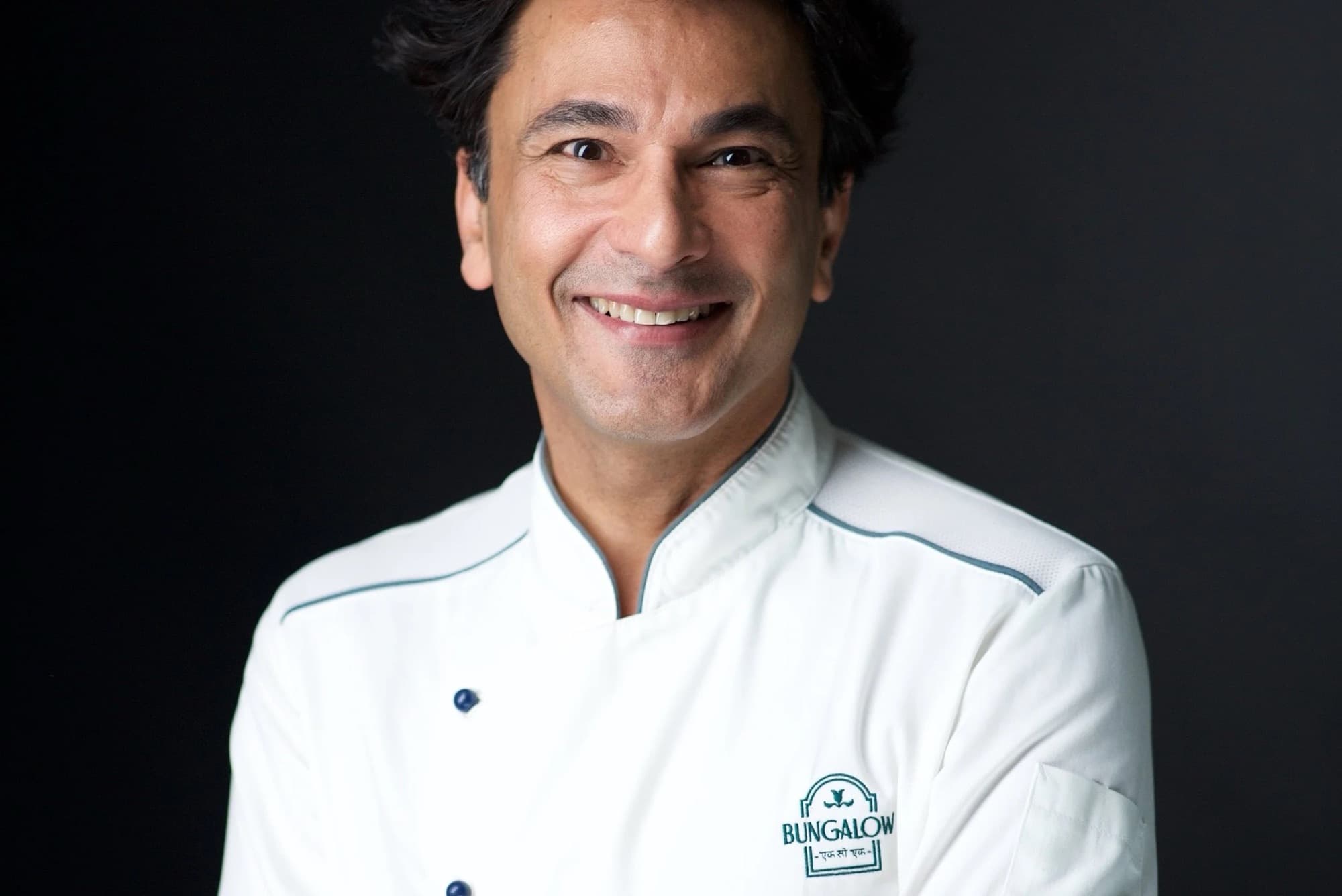
TIME named Vikas Khanna to its 2026 list of the world’s most influential people. Eric Ripert, who runs the three-star French restaurant Le Bernardin in New York, wrote the short tribute. Twenty-six years earlier, Khanna had arrived in the same city to a deli job that lasted a few weeks, in a dining culture that still treated Indian cooking as buffet work.
He did not invent Indian fine dining in America. Devi and Tabla had already argued for seriousness before Junoon. Khanna’s mark is visibility: a casual American diner, and a large Indian television audience, could picture a person when they heard “Indian chef.” The cook got a public name. The mild-tikka card did not disappear.
Amritsar to the Rescue Mission
Khanna grew up in Amritsar, rolling rotis in the Golden Temple langar as a child with his grandmother, then taking catering work as a teenager. Hotel kitchens followed: the Welcomgroup school in Manipal, then Taj, Oberoi, and Leela rooms. Colleagues pushed him toward “international” cooking. He wanted to stay with Indian food.
He landed in New York in early December 2000. A short deli job ended before Christmas. He spent weeks at the New York City Rescue Mission, cooking for other residents, then washed dishes and handed out flyers before landing at Salaam Bombay, the Tribeca Indian restaurant that later sponsored his green card.
The American default he met was a mild-to-hot slider, chicken tikka masala, and a lunch buffet that held. Indian restaurants were already in the city. A named Indian chef on television, the kind of public figure American food shows already built around French and Japanese cooks, was rare. Diners could like the food and still treat the cook as interchangeable. After 9/11, he has said, the racism got sharper. He put the energy into the work.
Fox, Flatiron, MasterChef India
In 2007 he appeared on Gordon Ramsay’s Kitchen Nightmares at Dillon’s, a confused Manhattan room Ramsay pushed toward Indian cooking and renamed Purnima. Khanna came in as the consultant chef who rebuilt the menu. Viewers watched an Indian cook as the specialist hired to fix a kitchen.
In December 2010, Junoon opened at 27 West 24th Street in Manhattan’s Flatiron District. Restaurateur Rajesh Bhardwaj, already known for the Café Spice group, owned the room. Khanna was executive chef. Walter D’Rozario, who had cooked at Devi and other New York Indian kitchens, was chef de cuisine. The card named cooking methods, tandoor, tawa, patthar hot stone, sigri fire pit, instead of a heat scale. A glass spice room sat downstairs.
New York Times critic Sam Sifton gave the restaurant two stars in March 2011, describing an Indian restaurant remade as a large, luxe destination with a serious wine list. Michelin awarded a star later that year. Junoon held it for years into the late 2010s. A diner who knew Indian food as a buffet was being asked to book a destination room.
The same year the star landed, Khanna replaced actor Akshay Kumar as a judge on MasterChef India season 2, joining chefs Ajay Chopra and Kunal Kapoor. Indian households got a New York chef as a weekly face. By the end of 2011 he had been on Fox, held a Manhattan star, and sat on Indian prime-time television. In that stretch he also made Holy Kitchens: True Business, a short film about Sikh langar, the free kitchen that feeds anyone who sits down at a gurdwara.
Palace set, then village heat
Devi, opened in 2004 by chefs Suvir Saran and Hemant Mathur, took a Michelin star in the 2007 New York guide, the first Indian restaurant in the United States to do so. Danny Meyer’s Tabla had spent a decade arguing that Indian cooking belonged next to the rest of Manhattan fine dining. It closed around the time Junoon opened.
Khanna has said Junoon needed to be lavish to answer chefs who thought Indian cooking was less. If the room looked as finished as a French or Italian dining room, the cooking would be taken seriously. Later New York kitchens, especially Vijay Kumar’s Tamil room Semma, showed that village cooking could take a star without the palace set. Lavish rooms made the category visible. Regional rooms made heat and offal harder to dismiss as commercially unsafe. The later U.S. star map is in How Indian Food in America Got Michelin Stars So Fast.
Pakistani, Bangladeshi, Sri Lankan, and regional Indian cooking still get flattened onto one card. Khanna’s fame did not fix that. It did give the next cook a name to point to, and a résumé line. Aarthi Sampath, who later opened Drāvida in the East Village, started at Junoon as an intern and left as chef de cuisine.
Feed India, then Bungalow
During India’s 2020 lockdown he ran Feed India from New York, after his mother told him to feed the country rather than talk about new restaurants. Early reporting put the drive around 20 million meals and ration kits across more than 125 cities. Later tallies go higher.
Bungalow opened March 23, 2024, at 24 First Avenue with restaurateur Jimmy Rizvi, whose GupShup group already knew how to fill a New York room. The date would have been the 50th birthday of Khanna’s sister Radhika, a fashion designer who died in 2022. The menu moves from Kashmir toward Kerala, with club and home cooking on the card. Michelin gave it a Bib Gourmand. New York Times critic Priya Krishna later named it a Critic’s Pick. Khanna has said the room is a ten-year promise, not a franchise plan: keep the memorial dinner going, then close. In 2026 he and Rizvi also put hospitality money into Kolkata Chai Co., a New York chai brand. See Vikas Khanna Just Put Chef Capital Behind a New York Chai Brand.
Most American “Indian” orders still look like tikka and naan. If you want the current Khanna room, try Bungalow when a table opens. If you cannot get in, pick a place that prints the chef’s name and a region on the card, then watch whether the next opening still softens the spice. Visibility was the first fight. Specificity is still open.
Further reading
- How Indian Food in America Got Michelin Stars So Fast
- New York’s Hardest Table Serves Village Tamil Food
- Vikas Khanna Just Put Chef Capital Behind a New York Chai Brand
- Why “Indian Food” Is the Wrong Menu Category
- Beyond Butter Chicken: Why South Asian Dining Got Hyper-Regional
- Why North Indian Food Still Owns Most American Menus
- GOLDSCENE: Aarthi Sampath, from Junoon to Drāvida
- GOLDSEA: India’s impact on American food culture
- AsiaMs / GOLDSEA: Asian chefs and NYC Michelin dining